Can a Sell Ladder Add Bitcoin Without a Forecast?
Sell half at 2× trend, half again at 3×, 4.5× and so on, and buy everything back when the price returns to the trend. Without a euphoria it costs nothing. With one it kept about 1.5 times a holder’s Bitcoin, whether or not the floor followed. Its lead depends on acting on daily closes and comes mostly from simulated worlds that swing wider than history.
Sell Into Euphoria, Buy Back at the Trend
A forecast-free sell ladder for Bitcoin, tested in twelve futures
The Question
How far above trend will Bitcoin go in its next euphoria? Nobody knows. On daily closes the cycle peaks were 15.8×, 11.0×, 6.2×, 3.3× and 1.25× the trend. If the shrinking continues, the next peak may not reach 2×. If it stops, it may.
So the Observatory’s owner asked for a rule that is ready for a 3× trend without needing one. It must work whether or not a euphoria comes, and whether or not the price returns to the floor.
Eight versions of a sell ladder were tested against holding and three Kelly rules, in walk-forward history (2012 to 2026) and in twelve simulated worlds of 2,000 paths each: seven built from the four observed cycle shapes, and the five statistical worlds of Paper 21. The decision rule was registered before any test ran.
The Rule
Hold through the band. Above it, sell half the Bitcoin held at each rung. Park the proceeds in cash. When the price comes back to the trend, buy it all back.
buy back all at 1.0× trend
The paper calls this L2-R1: first rung at 2×, buy-back R1 at the trend. Other versions start at 1.5× or buy back in thirds down to 0.5× (R3), near the floor (RF), or at half each sale price (RP).
Every sale races a clock. The trend keeps rising, so Bitcoin sold at a multiple is bought back cheaper only if the multiple later falls far enough.
| Sold in October 2026 at | Break-even after 1 year | After 2 years | After 3 years |
|---|---|---|---|
| 1.5× trend | 1.10× | 0.82× | 0.62× |
| 2× trend | 1.47× | 1.09× | 0.83× |
| 3× trend | 2.20× | 1.64× | 1.24× |
The Result
Under the registered rule, L2-R1 is the recommendation. Seven rules passed every core-world gate and beat holding in both families of worlds. L2-R1 had the highest score. One rule, L2-R3, which buys back in thirds down to half the trend, was level with it within simulation precision, and the registered rule recommends the simpler of the two.
Bitcoin kept against a holder, averaged over years 10 to 14. A score of 0.463 means about 1.6 times a holder’s Bitcoin on a weighted geometric average across the worlds.
No euphoria costs nothing. With peaks of 1.1× to 1.6× trend, the 2× ladders traded on under 1% of paths and kept a holder’s Bitcoin. One more euphoria pays, and L2-R1 is the least sensitive to whether the floor follows.
| Rule | Calm, floor | Calm, miss | Euphoria, floor | Euphoria, miss |
|---|---|---|---|---|
| L2-R1 | 1.00 | 1.00 | 1.52 | 1.47 |
| L2-R3 | 1.00 | 1.00 | 1.93 | 1.29 |
| L2-RP | 1.00 | 1.00 | 1.76 | 1.42 |
| L2-RF | 1.00 | 1.00 | 2.53 | 0.55 |
| Trend-anchored Kelly | 1.06 | 1.01 | 1.59 | 1.37 |
| Floor-Kelly | 1.48 | 0.68 | 1.44 | 0.63 |
Bitcoin kept against a holder in the four cycle worlds. Calm worlds peak at 1.1× to 1.6× trend; euphoria worlds have one peak at 2.5× to 4×. Buy-backs: R1 at the trend, R3 in thirds, RP at half each sale price, RF near the floor.
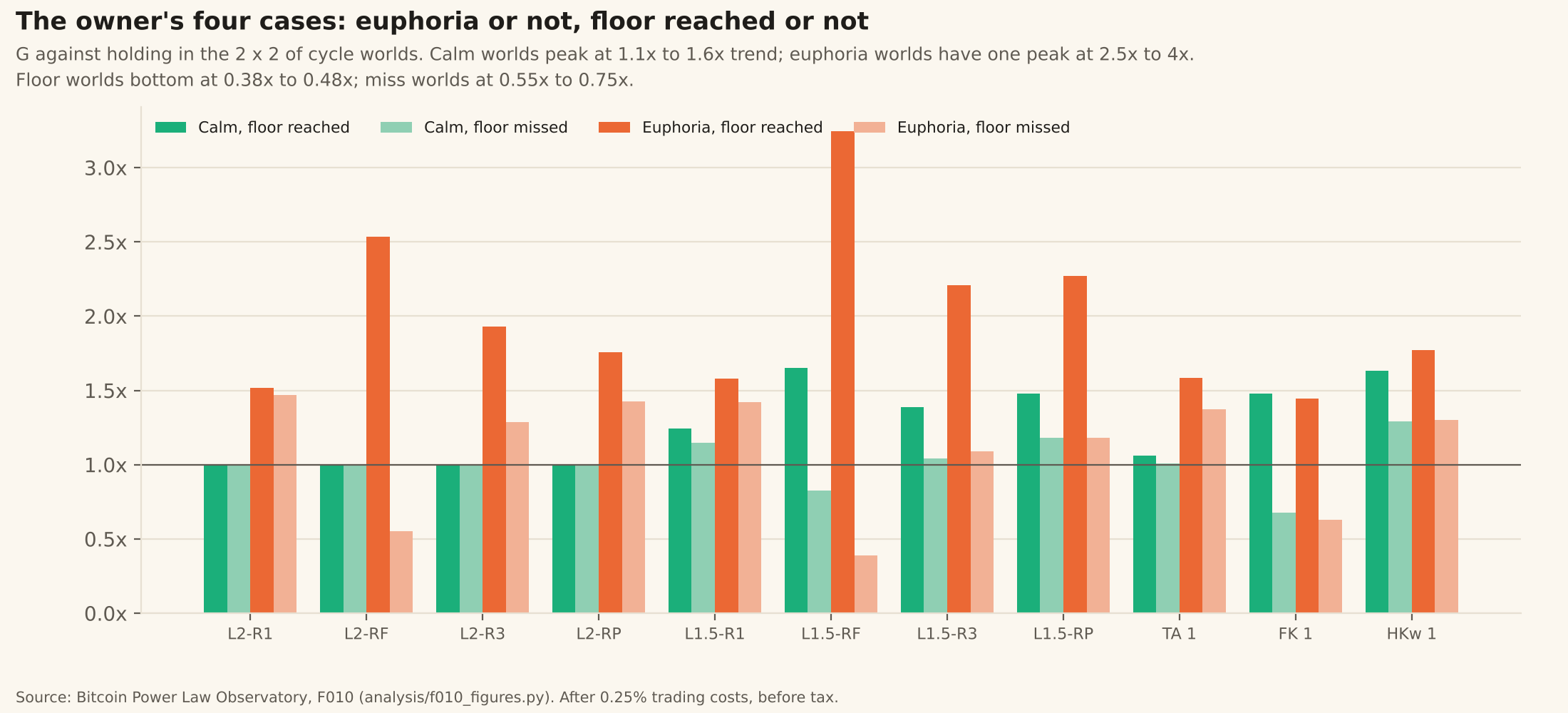
Waiting for the floor is a bet on the floor. Buying back only near the floor gave 2.53× when it came and 0.55× when it did not, with cash unspent on 98% of paths after 14 years. Floor-Kelly and the histogram Kelly were not robust and did not pass the gates.
The gain is timing, not exposure: L2-R1 beat a constant mix holding the same average Bitcoin (1.62× in the euphoria-with-floor world, against a mix rebalanced monthly).
Where the Lead Comes From
Its lead depends on acting on daily closes. Ladders fill on simulated daily closes; the Kelly rules rebalance at month-end. With month-end fills only, every 2× ladder’s score falls by 41% to 48%, and trend-anchored Kelly scores higher.
| Score by assumption | L2-R1 | Trend-anchored Kelly |
|---|---|---|
| Primary: daily fills, history’s intramonth moves | 0.463 | 0.374 |
| Month-end fills only | 0.250 | 0.374 |
| Intramonth moves × 0.75 | 0.359 | 0.374 |
| Gaussian bridge instead of history’s shapes | 0.342 | 0.374 |
An investor who keeps standing limit orders at the rungs and at the trend gets the ladder’s edge, if intramonth moves are as large as in the main simulation, whose dips in big months run deeper than history’s. An investor who acts once a month does better with trend-anchored Kelly.
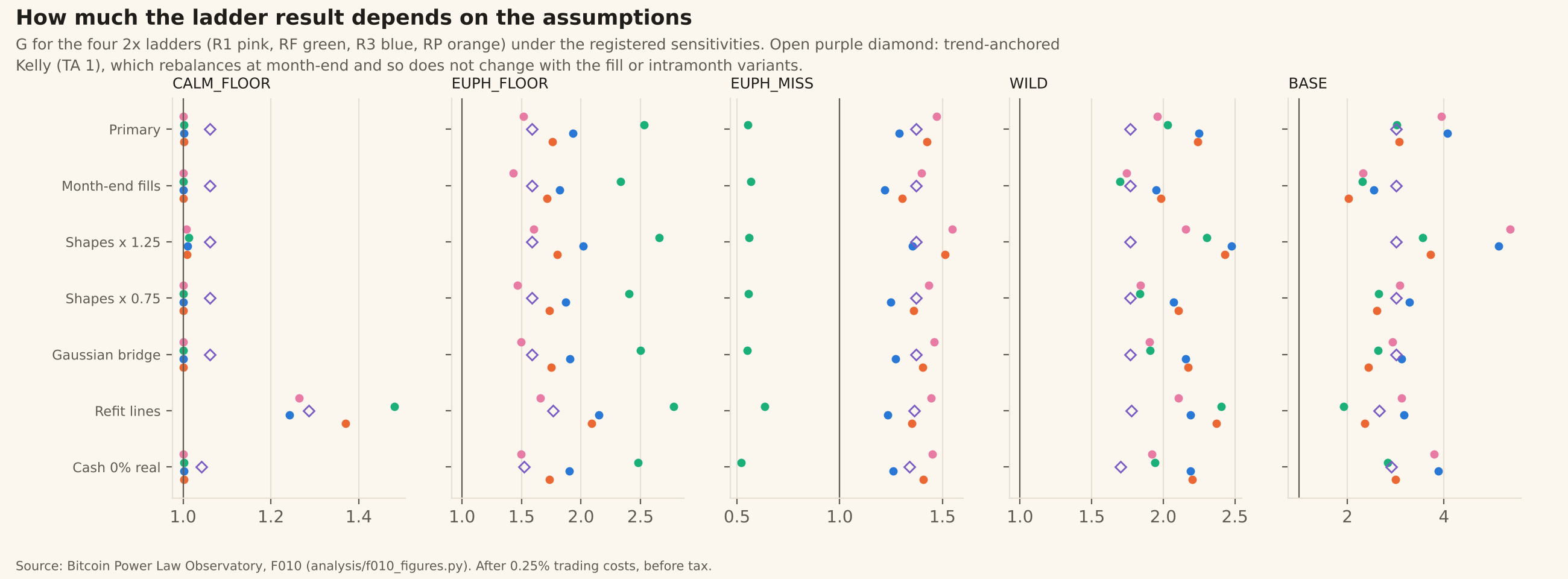
Most of the score comes from the statistical worlds, which swing wider than history (residual standard deviation 0.346 against 0.283). They carry half the weight but supply nearly three quarters of L2-R1’s score (0.335 of 0.463).
The registered intramonth check flagged every world: in the largest monthly moves, simulated dips run deeper than history’s. That helps buy orders fill, so the ladders’ simulated gains may be optimistic.
Stress and Long Horizons
If multiples ratchet up, the cash can stay idle for decades. The trend buy-back stops being reached. L2-R1 still kept 1.38× a holder’s Bitcoin at 10 to 14 years, but its median longest run more than half in cash was 211 months, and its ratio fell to 0.19× by year 30. The price-anchored variant L2-RP kept 1.49×.
In a random walk around the trend, every timing rule lost. L2-R1 kept 0.52×, and 10% of paths kept under 3%. L2-RP kept 0.83×.
| Stress world | L2-R1 | L2-RP |
|---|---|---|
| Multiples ratchet up, years 10 to 14 | 1.38× | 1.09× |
| Multiples ratchet up, year 30 | 0.19× | 1.49× |
| Random walk, years 10 to 14 | 0.52× | 0.83× |
| 30-year score | 0.763 | 0.821 |
Over 30 years L2-RP scores higher and is far more robust under stress. A 10% never-sold core is cheap partial insurance: it costs a little in a euphoria (1.52× to 1.47×) and lifts the random-walk world from 0.52× to 0.78×.
Money in and out. For a retiree, L2-R1 never lowered the 30-year safe withdrawal rate against holding (with month-end fills). For a saver, contributions wait in the cash pool, which hurt badly where the pool stays stuck (0.41× when multiples ratchet up, 0.32× in the random walk).
History
History since 2012 holds three euphoric cycles. It describes; it does not decide.
- Since 2016, every 2× ladder beat holding (1.11× to 2.09×), and the floor buy-back did best.
- From 2012, every ladder lost on walk-forward lines, mainly because the young walk-forward trend rose from 0.69× to 2.33× the published trend between the 2013 sales and the 2014 buy-back. On the published trend, L2-R1 from 2012 was 1.01×.
- Daily fills matter in history too. With month-end fills, the floor buy-back’s result since 2016 fell from 2.09× to 0.44×, a loss.
What Comes Next
The recommendation covers an investor who holds. A later study (Paper 23) tested L2-R1 for a retiree who spends from the stack. It found the same dependence on daily execution and on euphorias.
L2-R3, L2-RP and trend-anchored Kelly were tested afterwards in a registered addendum (F011-R) under the same spending. From today it recommends L2-R3, buying back in thirds (score 0.806 against 0.773); from the trend, from a peak, with wider intramonth swings and at lower spending, L2-R1. L2-RP remains the robust one where multiples drift or ratchet up.
Taxes are out of scope. Each ladder sale may be taxable, which for many investors favours holding. The rule is insurance against euphoria, not protection against the power law failing.
Read the Paper
31 pages, 12 figures, version 1.3. The eight ladders, the three Kelly rules, the twelve worlds, the registered decision rule, every sensitivity, the walk-forward history and the scorecard against the pre-registered predictions.
Sell into euphoria, buy back at the trend: it costs nothing without a euphoria, pays with one, and needs daily orders to keep its lead.