Can Kelly Sizing Add Bitcoin?
Feed Kelly the growth from today’s price to the power-law floor four years ahead, and it turns counter-cyclical. Walk-forward since 2014, it ended with more Bitcoin than buy and hold in 98% of start and end pairs. The timing edge is strong. The edge over holding is suggestive, not proven.
Kelly Sizing With Floor-Anchored Growth
A walk-forward test of a Bitcoin, gold and cash allocation rule against buy and hold
The Question
The Kelly criterion sizes a bet from its expected return and risk. Feed it Bitcoin’s historical average return and it says 100% Bitcoin, always. That is buy and hold with extra steps.
Bitcoin holders ask a sharper question: does using the cycles leave you with more Bitcoin than buying once and holding? We tested that directly, with monthly decisions that use only the data available at the time.
The Rule
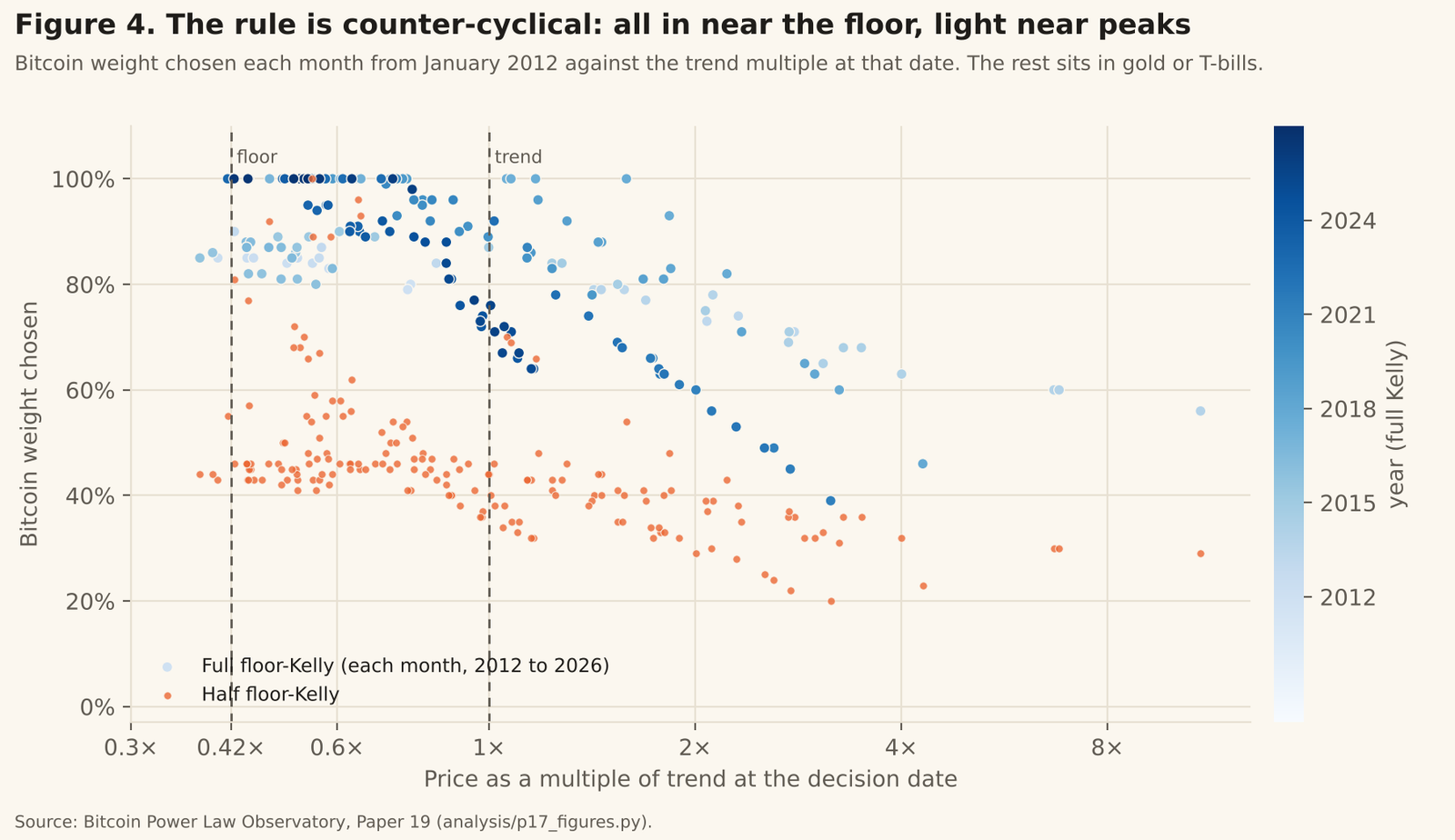
Replace the historical return with floor-anchored growth: the growth from today’s price to the power-law floor four years ahead. Near the floor it is high, so Kelly leans in. Near and above trend it is low or negative, so Kelly steps out into gold and cash.
The floor is the 1% quantile line of the power law, refit every month on the data known at the time.
This is not textbook Kelly. In the model’s own forecast the floor input sits near the 14th percentile, about one standard deviation below the central growth estimate. It is a cautious, robust-Kelly-style sizing rule.
The Result
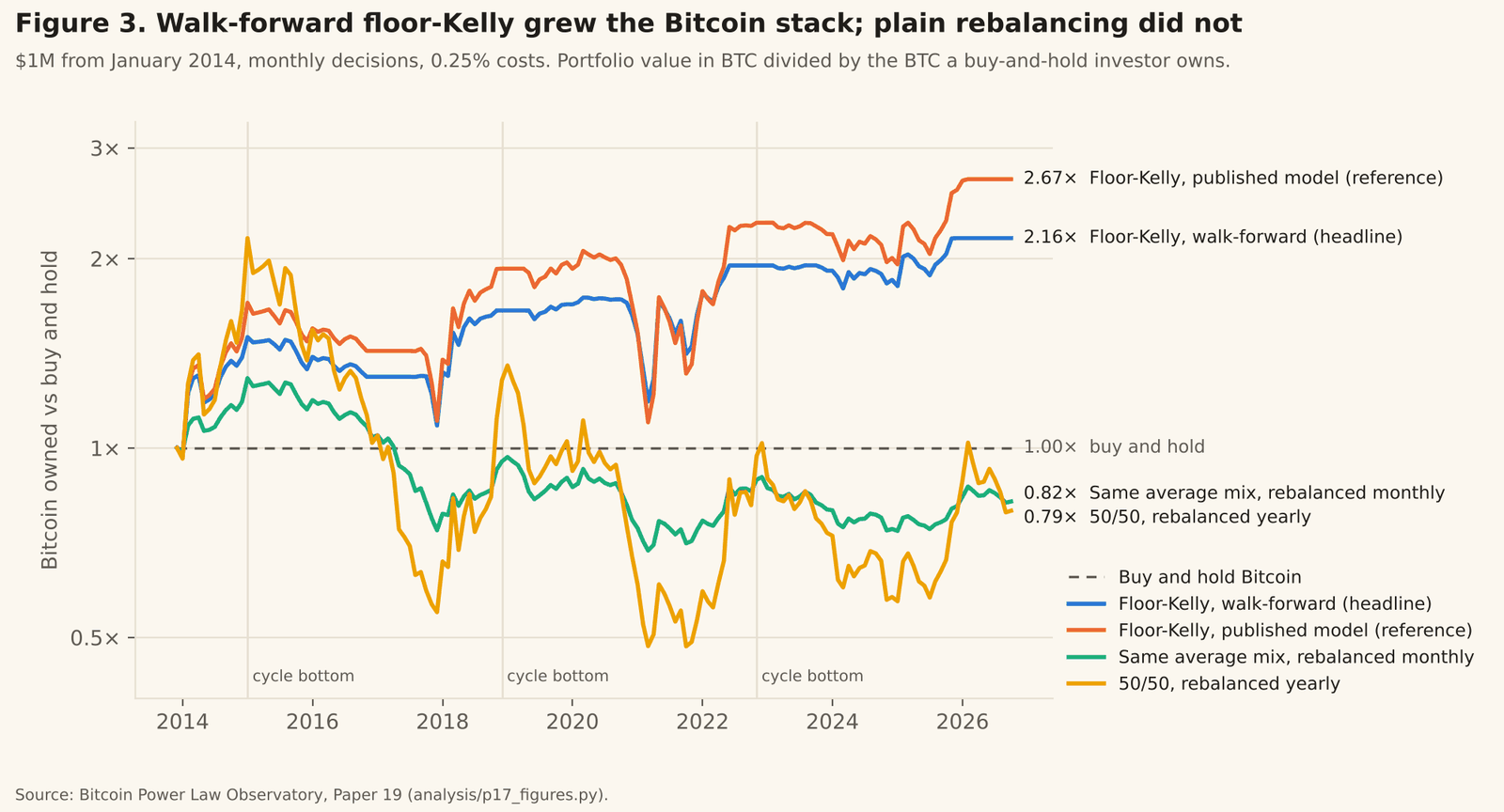
Full floor-Kelly sold Bitcoin into every bull run and bought it back near the floor. Measured from one cycle bottom to the next, its stack rose from 0.88× to 0.97× to 1.14× a holder’s.
| $1M from January 2012 | End value | Max drawdown | Stack vs hold |
|---|---|---|---|
| Buy and hold Bitcoin | $16.3B | −81% | 1.00× |
| Floor-Kelly, walk-forward (full) | $20.6B | −66% | 1.26× |
| Floor-Kelly, walk-forward (half) | $821M | −43% | 0.05× |
| 50/50 Bitcoin and gold, rebalanced yearly | $4.5B | −60% | 0.28× |
It was ahead from every January start from 2012 to 2025, in three independent four-year windows, and with the model frozen at December 2016, 2018, 2020 and 2022 and never recalibrated. All results are after 0.25% trading costs and before tax.
What Is Proven, and What Is Not
Strong: the timing adds value beyond rebalancing. Against a constant mix at the same average weights, the edge is +7.5% a year, Holm-adjusted p = 0.002 across all 12 floors explored. Seven of the eight power-law floors pass that test; none of the four other floor shapes do.
Suggestive: more Bitcoin than holding. +6.0% a year in log growth, but Holm-adjusted p = 0.46 and a deflated Sharpe ratio of 0.09 to 0.77 over the 57 configurations searched. With three or four cycles of history, the accumulation edge is not statistically established.
Specific to the power law. Four walk-forward floors with other shapes, including an on-chain realised-price floor and a 200-week moving average, ended ahead in 0% to 41% of pairs, against 99% for the power-law floor.
The whole search is disclosed, and a blind re-implementation from the text and data alone reproduced every number it tested.
Where It Fails
We built 14 simulated futures to break the rule. With the floor held at its October 2026 fit, it keeps its edge only while Bitcoin’s cycles persist. Refit inside each simulated path, as the backtested rule is, it ends behind holding at the median in 9 of 14 futures.
- Cycles fade: the edge disappears once cycle size has shrunk by about 90%.
- A permanent repricing above trend: the rule sells too early and ends with 0.63× a holder’s Bitcoin.
- Regime switching: a coin flip, 53% of paths ahead.
Half Kelly is a risk-control rule, not an accumulation rule: drawdowns of −37% to −43% and Sharpe ratios of 0.74 to 1.11, but behind holding in Bitcoin in 94% of pairs.
The floor itself is a level, not a boundary. Paper 20 shows that the 1% line, frozen at a date, was below price on a median 14% of later days. The rule still works because it uses the floor’s shape and swings, not its exact level.
The Live Record
History cannot settle this. On 6 November 2026 we froze the rule in a hash-locked file and started a monthly, append-only record, with pass and fail criteria registered before any outcome.
Bitcoin / gold weights. The first formal verdict is at the October 2030 close: is the full-Kelly track ahead of holding in Bitcoin?
Read the Paper
45 pages, 19 figures. The method, the walk-forward backtest, every start and end pair, the frozen-parameter tests, the full specification search with deflated Sharpe ratios, four alternative valuation floors, 14 simulated futures, the blind replication and the prospective record.
The floor makes Kelly counter-cyclical. History says the timing works; only the next cycles can say whether it keeps adding Bitcoin.